


Today is World Peace Day, so I thought it would be the perfect time to introduce the MANHATTAN PEACE PROJECT, also known as PROJECT UNITY — an initiative aimed at bringing about a state of global coordination and harmony. It was briefly mentioned on this Substack all the way back in 2022 in the post titled The Paradigm of Emergence: A Unifying Worldview for a Divided World and a Solution to the Meaning Crisis, but seeing as how the threat of a new world war is no longer just hypothetical, it’s time to ramp things up.
The U.S. is currently at war with Iran, and I have dozens of family members living in Tehran — three uncles and an aunt and all their kids and kids’ kids — so you could say the project has become personal. Earlier this year, after President Trump warned Iran that if the Strait of Hormuz wasn’t opened, “you’ll be living in Hell,” one of my cousins — a woman in her twenties with basically her whole life ahead of her (below) — sent me the following reply after I wrote her pleading for the family to leave Tehran:
“I have to tell the family, tonight is a difficult night for us, pray for us, the sounds are really loud, I hope the war ends as soon as possible."
That is something no one should ever have to hear from a family member, especially one so young and so completely removed from the politics and decisions driving a conflict she had no part in creating.

We are wired to feel the suffering closest to us most acutely, but if we genuinely believe that every innocent life has equal value — and I think most of us do — then we have to reckon with the fact that the people caught in any war zone are someone's family. They are human beings no different from the ones we would risk our lives to protect. The Iranian mother, the Palestinian child, the Israeli teenager — they have nothing to do with any of this. They did not design these conflicts, declare these wars, or draw these battle lines. And if any of them have come to see the other side as an enemy, that perception was not born in them — it was built, deliberately, through years of propaganda and dehumanizing rhetoric that serves the people who start wars, not the people who suffer them.
And that propaganda is all around us right now — in the suggestion that civilians in Gaza somehow brought it on themselves, that Iranians are driven by hatred of the West, that the entire Muslim world wants to harm us. My experience tells a different story. My family in Iran has been in love with American culture for as long as I can remember. In the ’80s they were obsessed with Michael Jackson and Michael Jordan. Every time my dad visited, he would bring a suitcase full of Nike shoes, Ray-Ban glasses, and American designer perfumes for twenty something family members who were always caught up on the latest Western trend. Here is some of my family in Iran celebrating Christmas.

These are not people who hate Americans, or the American way of life. Nothing could be further from the truth. I dare anyone who thinks so to learn about Iranian culture, to hear what their music sounds like, to see what their parties are like, to see how they talk and what they talk about. That is the first challenge that Project Unity poses to every American — take some time to find out as much about Persian culture as Persians know about our culture. If that understanding reached critical mass, the downstream effects could cascade through society, changing the very conditions that make war possible.
Most of us already know that war is horrible. But many of us have also been convinced that it is unavoidable—a necessary evil built into human nature and the way civilizations work. In this article, I want to convince you that this is simply not true. War is not only barbaric; it is often irrational. Nature is competitive, but evolution’s greatest leaps have come through cooperation: cells joining to form organisms, organisms forming societies, and human beings organizing themselves into ever-larger communities and civilizations. Cooperation is the most powerful engine for building higher levels of complexity and order. The Manhattan Peace Project begins from a simple premise: if cooperation is what allows complex systems to become more capable, resilient, and intelligent, then world peace should be treated not as a utopian fantasy, but as the optimal configuration for humanity.
So why is it called the Manhattan Peace Project?
The original Manhattan Project brought together an extraordinary concentration of scientific talent during World War II to solve what seemed like an existential problem. The project began from the premise that Nazi Germany might develop an atomic weapon first, and the United States mobilized physicists, engineers, industry, and government on an unprecedented scale to beat them to it. They succeeded.
Germany surrendered before the bomb was used. Three months later, the United States dropped atomic bombs on Hiroshima and Nagasaki. By the end of 1945, more than 200,000 people had died as a direct result of the bombings, and humanity had entered the nuclear age. The historical debate over whether those bombings were necessary to force Japan’s surrender continues to this day. I tend to believe that demonstrating the same terrifying power on an uninhabited target could have achieved the same strategic goal without killing hundreds of thousands of people, though of course we can never know for certain. Regardless of what you believe about that, the invention of nuclear weapons ushered humanity into an unprecedented era of existential risk.
Project Unity asks a simple question:
What if we did that for peace?
What if we gathered scientists, systems theorists, psychologists, artists, musicians, technologists, philosophers, and ordinary people around an equally ambitious problem— not how to win a war, but how to make war obsolete?
That is the Manhattan Peace Project.
The Planetary Cooperation Barrier
My colleague Clément Vidal at the Evo-Devo Institute has given this problem a name that I think cuts through a lot of confusion: the planetary cooperation barrier.
In a new paper, Clément makes an argument that sounds simple but has profound implications: the problem of global coordination is not a moral problem — it is a design problem. And design problems have solutions.
Drawing on cybernetics, evolutionary theory, and game theory, he shows that the current international order is not failing because human beings are inherently self-serving or because peace is hopelessly naive. It is failing because the architecture is wrong. We have a world full of institutions generating accurate warnings about existential threats; what we lack is a governance layer capable of acting on those warnings. The knowledge exists but the structure to use it doesn’t.
The historical precedent he opens with is striking. In 1787, thirteen sovereign American states that were effectively in trade wars with each other, disputing borders and competing for advantage, came together at the Constitutional Convention. They did not abolish state boundaries or merge into a single homogeneous unit. They integrated into a higher-level system that constrained their behavior on matters of collective concern while preserving their individual identities. That is the model. Not a world government. Not the erasure of national sovereignty. Unity without uniformity.
Evolutionary theory, Clément argues, suggests we are now at exactly this kind of threshold — what scientists call a major evolutionary transition. The same logic that took us from single cells to multicellular organisms, from individuals to societies, now points toward a higher level of coordination among nation-states. It isn’t utopian. It is what complex systems naturally do when the pressure is sufficient and the conditions are right.
The question is whether we can make the conditions right deliberately, before catastrophe makes them right for us.
That question is not new for me, as long-time readers of this Substack will know. It is one I’ve been circling for years in posts like the following:
Terror Management Theory Suggests That a Unifying Worldview is the Solution to Tribalism, Political Polarization, and the Culture War
Game Theory of Mind: A Psychological Framework for Understanding Human Interaction and Resolving Conflict
Harmonizing Humanity: A Unifying Worldview is the Only Lasting Solution to Peace in the Middle East
The goal of global coordination also became a major theme of my forthcoming book, Our Cosmic Purpose. Chapter 8 introduces Project Omega (which includes Project Unity), an attempt to think seriously about what humanity must do to bring about the noosphere — a planetary layer of collective intelligence that emerges as human minds, cultures, technologies, and institutions become increasingly interconnected and coordinated.
Clément’s work on the planetary cooperation barrier is also directed at noosphere emergence. His paper approaches the problem from the level of institutions. Project Omega approaches the same problem from the other direction: What has to change in the way individuals think and act for such a transition to become possible?
The Pseudospecies Problem
One of the stranger facts about human beings is that we are a single species that repeatedly behaves as though we are many. In Our Cosmic Purpose, I borrow a term used by the complexity theorist Harold Morowitz in his book The Emergence of Everything: pseudospecies. Human cultures construct boundaries between groups where no biological boundary actually exists. Religion, nationality, ethnicity, and political ideology can bind millions of strangers into a cooperative group—but the same mechanism that creates an us also creates a them.
That produces something resembling the ecological problem of competitive exclusion. In ecology, two species attempting to occupy the same niche while competing for the same limiting resources cannot indefinitely coexist under the same conditions. Project Omega uses this as a model for what happens when human groups come to see the world as a zero-sum game for territory, resources, security, status, or identity. Instead of seeing the other group as potential partners inside a larger system, each begins treating the other as a competing population whose gain must be its loss.
Here lies the paradox: the same cognitive machinery that made civilization possible can also tear civilization apart. Shared worldviews are incredibly powerful coordination technologies. They give people common values, common stories, common goals, and enough trust to cooperate with strangers. But once those stories harden into mutually exclusive identities, the coordination mechanism becomes a conflict mechanism. The tribe becomes a pseudospecies.
That is when another human being can stop looking like someone’s daughter or father and start looking like an abstraction: Iranian. American. Muslim. Jew. Palestinian. Israeli. Enemy.
This is why propaganda is so powerful. It does not merely give people false information. At its most dangerous, it changes the resolution at which we model other human beings. A person becomes a category.
And categories are much easier to hate than people.
The Cooperation Principle
This is where the psychological side of Project Unity comes in.
In a 2023 post that introduced my conflict resolution framework called Game Theory of Mind, I described something like a cognitive switch between two modes of thinking. One is fast, reactive, tribal, and threat-sensitive (Mind A). When we feel attacked, this mode rapidly sorts the social world into allies and enemies. The other is more regulated, reflective and meta-aware (Mind B). It can step outside the immediate emotional frame, model the other person’s perspective, examine its own assumptions, and ask whether the conflict can be turned into cooperation by aligning interests.
The point is not that we can reason our way out of every conflict. The point is that humans can become aware of the psychological machinery driving the conflict — and choose not to let it escalate into catastrophe. We can notice the us-versus-them program while it is running.
That matters because pseudospecies are partly constructed inside our models of the world. If the model changes, the social reality can change with it. Our Cosmic Purpose argues that meta-awareness gives us a way of recognizing these artificial barriers without pretending that genuine cultural, religious, political, and national differences do not exist. Again: unity without uniformity.
It is important to remember that the cooperation principle does not mean eliminating competition. Competition is useful. It generates variation, experimentation, innovation, and excellence. The trick is to nest competition inside cooperation.
Football teams compete fiercely, but they agree on the rules, the field, and the fact that neither side gets to burn down the stadium when it loses. American states compete for businesses, talent, sports championships, and political influence while participating in a larger cooperative structure.
The same logic has to move up another level.
Countries can compete economically, scientifically, culturally, and technologically while sharing one non-negotiable objective: Do not destroy the game board.
From Theory to Project
Project Unity is an attempt to make the cooperation principle a conscious collective strategy. That means attacking the problem from both directions at once: from the top down, by designing institutions, incentives, and feedback systems that make cooperation rational and stable; and from the bottom up, by helping people recognize the psychological processes that turn difference into tribal conflict.
Over the next year, I want to work with colleagues at the Evo-Devo Institute and a wider network of scientists, technologists, psychologists, artists, diplomats, and other collaborators to begin turning these ideas into an actual strategy. Clément’s planetary cooperation barrier provides an important scientific foundation: evolutionary theory tells us what kind of transition we are trying to achieve, cybernetics helps us think about the architecture required to coordinate a complex planetary system, and game theory helps us design incentives that make cooperation advantageous rather than merely admirable.
But institutions alone will not get us there. Neither will changing individual minds while leaving the surrounding incentive structures untouched. The challenge is to create a positive feedback loop in which more cooperative minds build more cooperative systems, and better systems make cooperation increasingly easy, rational, and self-reinforcing.
So this is not the Project Unity strategic plan. It is the announcement that we are going to start building one. The goal is to spend the next year studying how humanity might deliberately cross the planetary cooperation barrier and release a proper strategy on World Peace Day 2027.
Today we simply name the problem, so we can start trying to solve it.
Reframing “the Enemy”
I’m only half Persian (half Kentucky hillbilly) and I speak very little Farsi, and because I looked more like my mom growing up, I didn’t really feel Persian when I looked in the mirror. But looking back on my childhood, life was pretty Persian-y. Our home was decorated with all this Iranian stuff that I can’t easily describe, like these big ornate silver plates that hung on the wall, or the Persian lanterns that hung above them. Here I’m wearing a Persian hat, but I think it was because I was really into rap and I thought it looked like something the X-Clan guys would wear. Anyway, point is, the older I get and the more I look back on my youth, the more I understand how Persian culture subtly shaped it.

There were Persian carpets on the floor, a golden samovar on the shelf (essentially a big fancy metal teapot), framed calligraphy and artwork. Most of my parents’ friends were Persian. My Iranian cousins from California and Canada visited every couple of years. We ate Persian food at least once a week. The Iranian vibe was quiet but always there in the background.
Around the time Covid hit, when I was writing my first book The Romance of Reality in quarantine, I got more curious about my roots. It began when Spotify serendipitously served up some revolution-era Iranian psychedelic rock — music made in the ’70s just before everything changed — and I fell completely in love with it. Check out this banger below from Kourosh Yaghmaei, who you might call the Persian John Lennon.
This 1991 song Saale Dohezar from Dariush is also strangely hypnotic and perfect movie soundtrack material. And this track by Zia called Helel Yos is genuinely one of the strangest, funkiest things I’ve ever heard, which is probably why the hip hop producer The Alchemist sampled it for the Action Bronson song Sven. There were also brilliant female artists like Googoosh and Giti who made some real gems. You can hear all the complexity and nuance of Iranian thought in this music.
Because I think it’s so amazing, I've put together a Spotify playlist — Project Unity: Persian Excursion — as an introduction. Near the end are two roughly hour-long extended mixes by Omid Walizadeh, a Long Beach-based hip hop producer who remixes classic and new Iranian songs in a way that creates a trippy cultural experience.
If you dig the mixtape, send it to a friend or two who you think might enjoy it. If you want, mutate it and send them your customized version. When these songs are heard a few times, the listener creates a mental model of the songwriter. You realize the music was made by people who were feeling the same emotions and telling the same stories as us. And when you understand how they are like us, but different, it becomes much harder to accept a story that tells you they are your enemy.
That is Project Unity’s “Bill and Ted Play”: use music to do what diplomacy hasn’t managed. We believe music can save the world, because it is the universal language. Let’s start with a playlist and see what happens.
The more I dug into Persian culture, the more I wanted to understand what was underneath it. That's when I started reading about Zoroastrianism, and it completely blew my mind. The ancient Persian religion is built around a cosmic struggle between Asha—truth, order, and right alignment—and Druj—falsehood, deception, and disorder. What struck me immediately was that this was the same basic cosmology I had been developing in scientific language: a universe in which life, intelligence, knowledge, and order emerge through an ongoing struggle against chaos, entropy, and disintegration. Zoroastrianism ended up becoming an important part of Our Cosmic Purpose for exactly that reason.
That investigation also changed how I thought about the religions that are so often presented to us as natural enemies. Judaism, Christianity, and Islam are not three unrelated systems that happened to collide; they are branches of the same Abrahamic story. Islam recognizes figures like Abraham, Moses, Mary, and Jesus—Jesus is revered as a prophet and Messiah—and presents itself as continuing the same monotheistic tradition rather than appearing from nowhere in opposition to it. Judaism and Islam likewise share deep structural similarities in theology, law, ritual, and ethics.
That is one of the ideas behind the Meta-Religion chapter of Our Cosmic Purpose: not that all religions are identical, but that traditions we have been taught to see as fundamentally opposed are often different cultural expressions of overlapping moral and metaphysical concerns. The divisive narrative tells us to stare at the differences. A metasystemic view asks what larger story they might all be participating in. As I put it in the book: We are many traditions. We are one story.
Finally I should mention that Persian civilization gave the world some of its most beautiful poetry, cosmic poetry obviously inspired by the spiritual roots of Zoroastrianism and Islam. Rumi has become global pop culture — you’ve seen him quoted by celebrities of all kinds and colors. There are also Omar Khayyam, Ferdowsi, and Hafez. Iran has given us some of the richest culture on earth.
The lesson is that what we have been told about Iran is not the story of the Persian people. Political games have been played for decades if not a century to keep that story buried — to keep us locked in an ideological conflict that serves the system, not the people. The Persian people I know and love are not that story. I hope this article has done a little to show you that they are much more like you than the cable news channel would have you believe.
If you are Persian and you’re reading this and would like a copy of my first book The Romance of Reality: How the Universe Organizes Itself to Create Life, Consciousness, and Cosmic Complexity in Farsi, email me at bobbyazarian@gmail.com and I will send you a PDF copy. It was released in two editions and even had a little promotional event at Tabriz University in Iran.
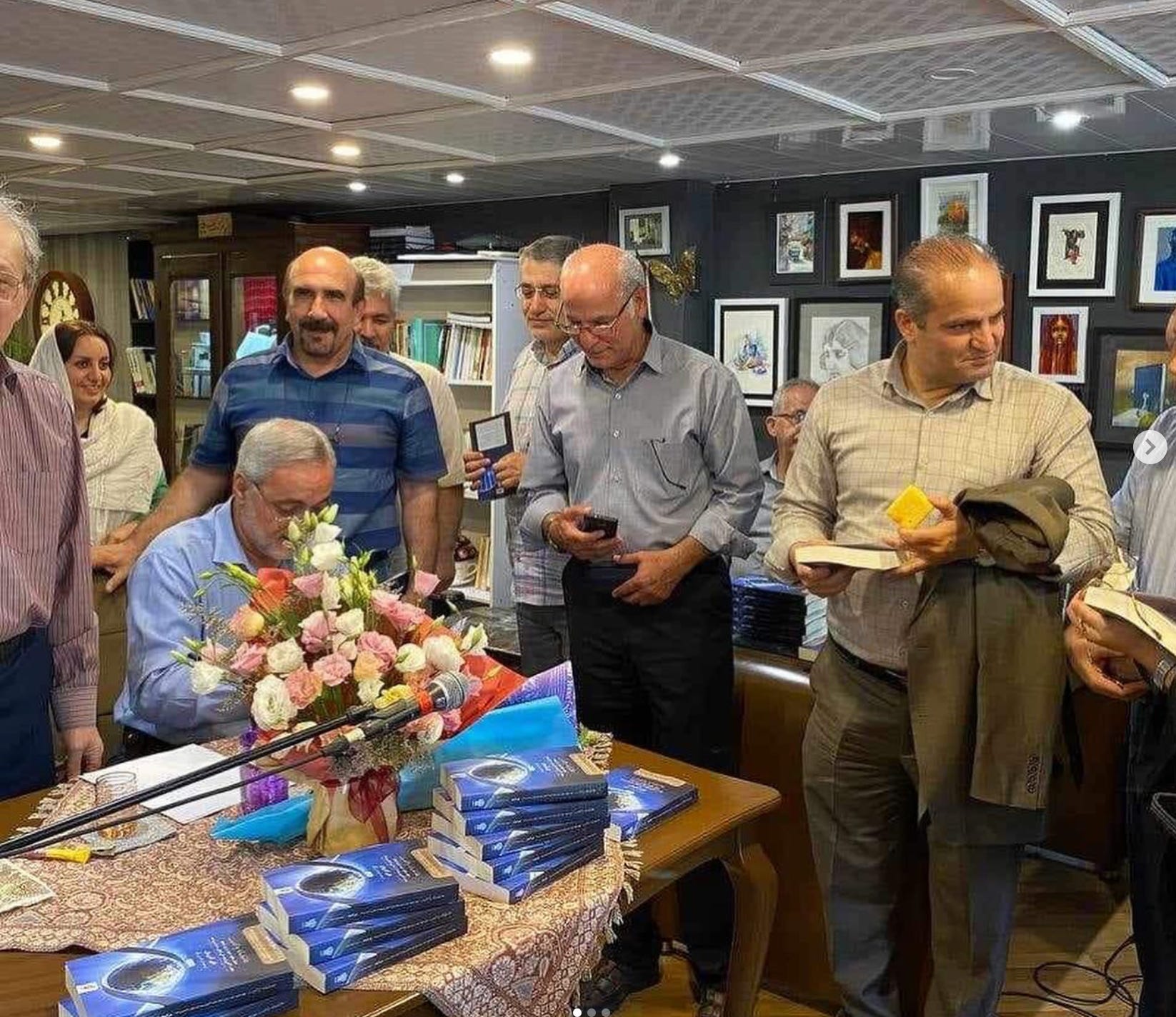
And if you are a Persian who would like to get involved with Project Unity, I’d love to hear from you.
Here is a picture of my grandfather, who is nearing 100, and my grandmother Izzie, who passed away from Covid in 2022 (posted by my cousin). I love you Izzie.

Ambitious vision for collective intelligence and systemic peace engineering. Scaling complex adaptive solutions requires recognizing the nonlinear friction and energy barriers of human conflict. I examined technological acceleration and growth limits here: https://gzambrano.substack.com/p/technological-singularity-the-derivative-that-deceives-every-generation
Actually, it's a lot simpler than that. No US citizen has any right to talk about "peace" whatsoever. The single most effective action in terms of promoting peace would be for the US to get out of all the countries and regions where it has a military presence. Sure, that might lead to different kinds of armed conflict, but given that the vast majority of serious conflicts in the last 25 years (and more) have been directly instigated by the US, it's pointless to talk about "peace" until that happens.